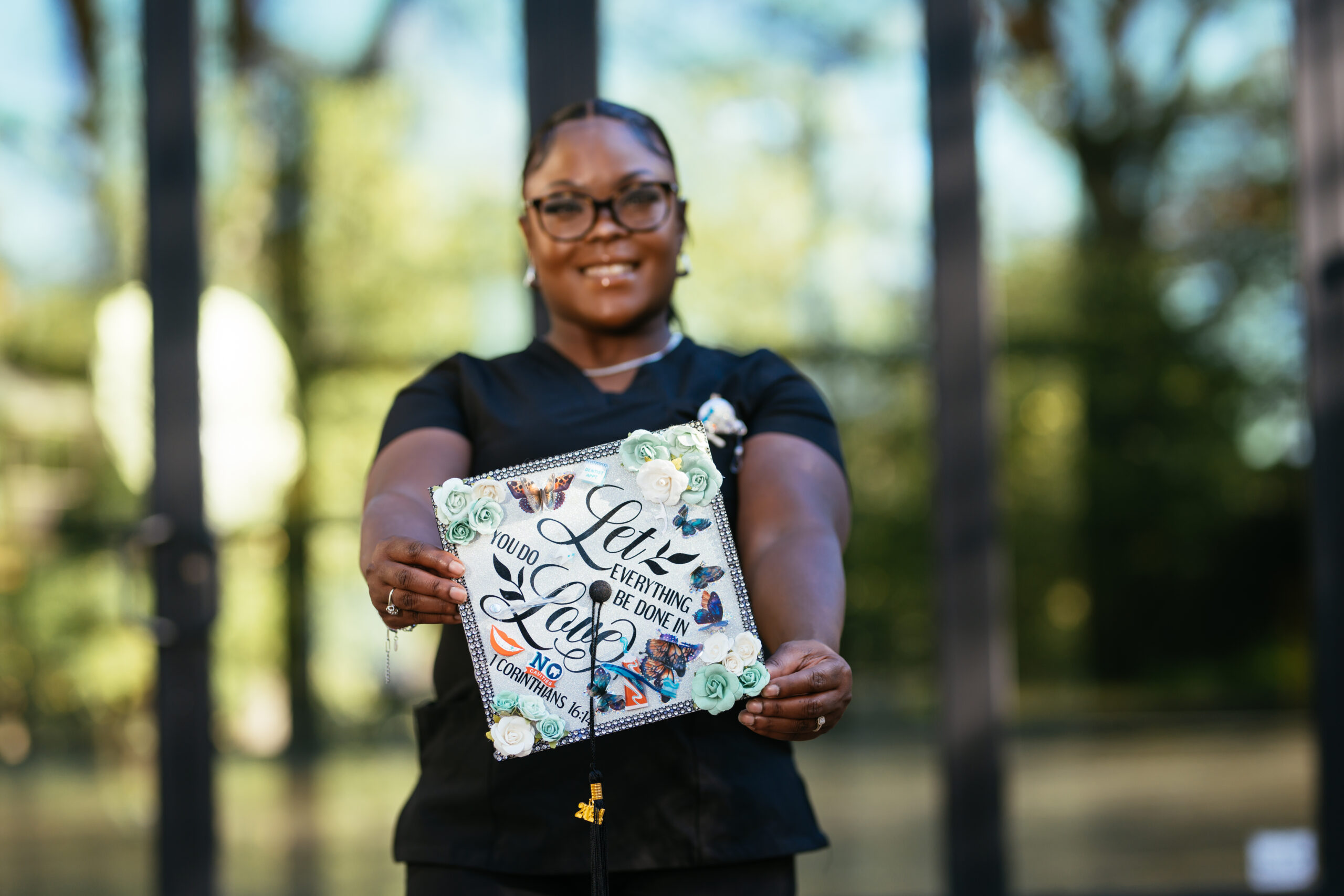
Madasia Middlebrook beams as she shows off her graduation cap, decorated with glitter, flowers and the words: Let everything you do be done in love. She shuffles through a set of documents– her degree as a dental assistant, which she earned in November 2024, and certificates in corona polishing, sealants, radiology, and nitrous gas, which she wrapped up in May of this year.
She always wanted a career that she and her two boys, Layden (15) and Zade (7) could be proud of. Years ago, she had studied to be a Certified Nursing Assistant, but as a single mom with little outside help, there was no time to pursue the work. Plus, earning too much income could threaten the food and housing benefits her family depended on, a phenomenon known as the benefits cliff. Like many parents and caregivers struggling to make ends meet across East Tennessee, she felt stuck.
“I’d set goals, but because I didn’t have any kind of outside help or even family to help me, I wouldn’t be able to accomplish my goals wholeheartedly,” she explained.
In April 2024, Madasia joined United Way of Greater Knoxville’s East Tennessee Collaborative Program (ETC) and was paired with mobility mentor Becca Pace, a licensed master social worker at the YWCA of Knoxville. Funded by the Tennessee Department of Human Services, the ETC program empowers parents and caregivers living below the poverty line or those in a group known as asset-limited, income-constrained employed (ALICE) to overcome hurdles to reach financial independence. In Knox County, 40 percent of households fall into these two categories.
Through ETC, participants have access to mentoring, career planning, basic needs assistance and skill enhancement to work toward goals around education and employment, financial security, and family stability and well-being.
Mentors like Becca, who come from community organizations across East Tennessee, serve as coaches, springboards, and connectors who helping participants set goals, navigate systems, find community resources, and weather challenging times while they work toward financial independence. The program also provides financial assistance to help participants with emergency expenses, moving costs, education, transportation, and childcare while they work on their goals.
“Being a mentor is such a different role than I’ve had in any other social work position,” said Becca, who mentors 20 ETC participants across three East Tennessee counties. “To be able to provide that financial support as well as the mentorship, a lot of times it’s either one or the other. Having that resource within the program itself eliminates so many barriers.”
Altogether, ETC’s 22 mentors have served 741 participants across ten counties. As participants make progress on their goals, their families benefit too, including 881 adults and 1,618 children living in poverty or in asset-limited, income-constrained households.

Education as a path to employment
Becca and Madasia started out by setting goals that Madasia would pursue as she worked to achieve economic mobility. ETC participants can set goals across eight categories—Housing, Family Stability, Physical and Mental Health, Networks, Debt Reduction, Savings, Educational Attainment, Employment / Career Management. During their time with ETC, participants may work on one or multiple goals at a time and create additional goals as they progress.
While Madaisa set goals for her finances and family life, most of her goals centered on finding and completing an educational program that would help her launch a career. She knew that education was going to be her clearest path to financial independence. In fact, research shows that earning an associate’s degree alone can increase lifetime earnings by $200,000. Through ETC, 135 participants have attained a new degree, more than 40 percent at an associate’s level or higher “Madasia came into the program knowing that she wanted to complete some sort of education program to get her to employment.” Becca explained. “She wants to make the best decision. She really looks at her options.”
Madasia sought to return to healthcare, a field with which she was familiar from her time studying to be a Certified Nursing Assistant years ago. After researching phlebotomy and nursing, she landed on becoming a dental assistant through a four-month program at the Dental Staff School of Knoxville. Together, Becca and Madasia prepared ahead of time for things like transportation to classes and childcare while she attended school, which took place on Saturdays. The American Jobs Center, another community resource, would help with her tuition.
“We already planned ahead, so it wasn’t really that hard,” Madasia said. “It was just staying motivated to do it.”
Becca and Madasia have met monthly to review progress and set new goals like getting her sons into a summer program and preparing for her job search.

A foundation for the future
In June, Madasia completed her final dental externship, the last step to round out her education before working in the dental field. The extra certificates she earned make her a more competitive applicant. Becca and Madasia have discussed what may happen if her income leads to a reduction in benefits, a critical point where ETC is able to fill the gap for a short period while participants grow their earnings.
She knows her kids are watching as she takes these steps forward.
“Them being able to see me accomplish the stuff that I talked to them and encouraged them about, it makes me feel good,” she said.
She regularly recommends the ETC program to other mothers in her community who want to build a more financially secure future, but do not know where to start.
“The lack of support can make you stay down. I needed support. People need support,” she said. “It’s because of the program I’ve been able to hold my chest up and breathe.”
As she looks ahead, Madasia has a new goal: home ownership. As she reaches these milestones on her path to economic mobility and transitions out of the ETC program, her formal mentorship with Becca will end. She will hold on to the newfound confidence in herself and the knowledge that there are community resources to help her along the way.
“There is a lot of help available for people. It’s about putting yourself out there and being vulnerable,” she said. “It’s about your life.”