
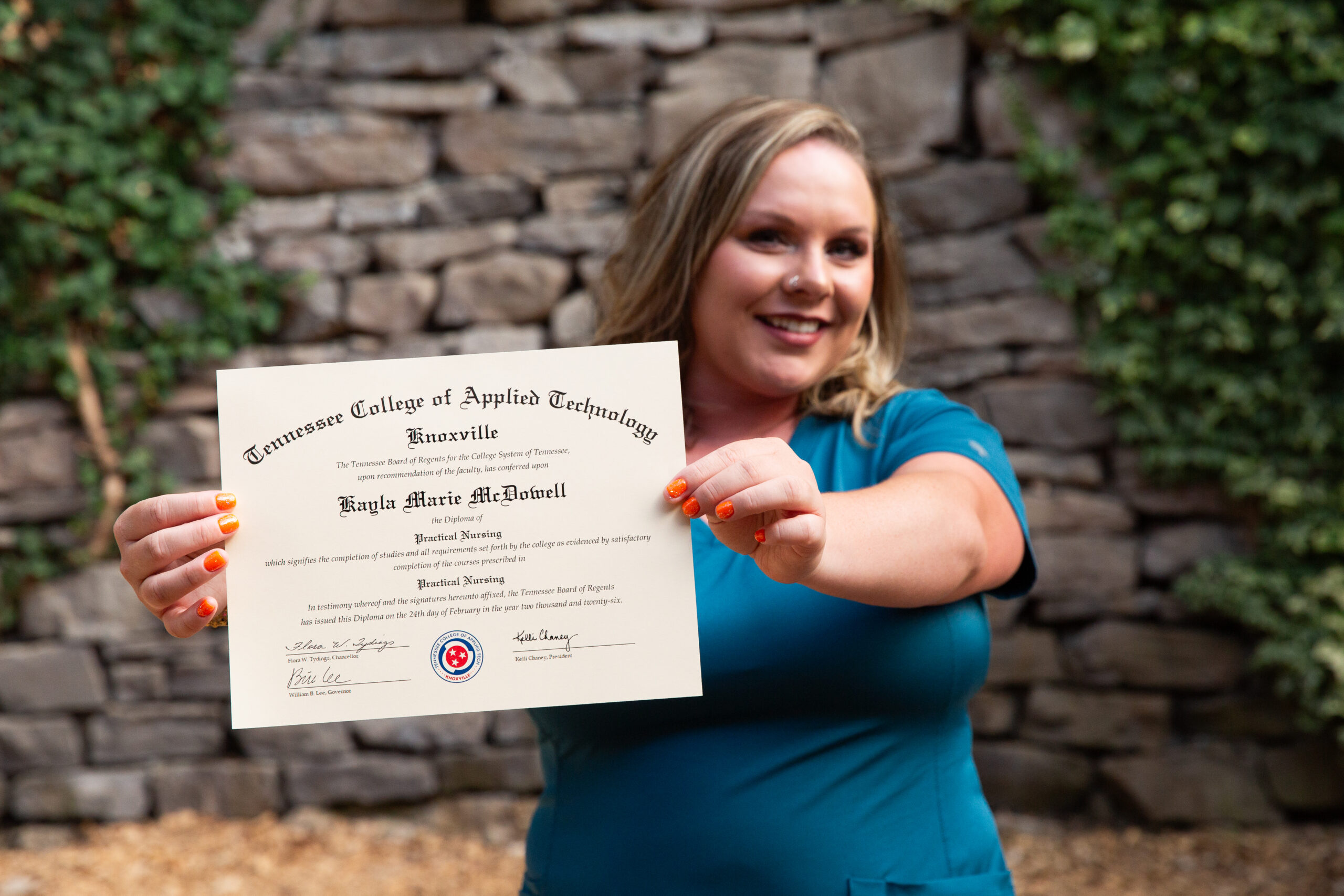
Kayla got the news that her grandfather had passed just two days before her NCLEX exam — the test that would determine whether she would become a Licensed Practical Nurse (LPN), whether the sacrifices she’d made over the last year would pay off.
Long shifts as a CNA alternated with study sessions and classes, a medical scare for her daughter, her grandparents growing sicker, her father’s incarceration, strained finances. Kayla was on the cusp of a career that would bring stability to her family — but she wasn’t sure she could handle one more loss.
“I was thinking to myself, ‘I can just throw the towel in. How am I going to take my state boards when something like this has just happened?’” she recalled.

Born and raised in Blount County to parents who struggled with addiction, Kayla learned early to rely on herself. She became a certified nursing assistant and bought a house at 22, but raising a child alone on a CNA’s salary was challenging. Kayla’s income put her in the “ugly medium” as she calls it — making too much to qualify for benefits but not making enough to cover all her family’s needs.
In the spring of 2024, Kayla walked into Good Neighbors to see if they could help her with an overdue electric bill. They provided aid, helped her enroll in a budgeting and financial literacy class, and introduced her to United Way’s East Tennessee Collaborative program (ETC).
Funded by the Tennessee Department of Human Services, ETC helps parents and caregivers below the poverty line, or who are ALICE (asset-limited, income-constrained, employed), reach financial independence. In Blount County, 37% of households fall into these categories; for single-parent, female-headed households, that figure climbs to 74%.
Through ETC, participants have access to mentoring, career planning, basic needs assistance and skill enhancement to work toward goals around education and employment, financial security, and family stability and well-being.
Building Toward the Dream
Not long after joining ETC, Kayla was paired with mobility mentor Courtney Boyce at Good Neighbors, where she had first sought support. Kayla had her sights set on becoming an LPN, but first she needed to prepare her finances: reducing expenses, paying down debt, and building a budget to cut back her work hours as she geared up for classes.
The two set manageable goals and little by little Kayla made progress, leaning on the tools she was learning from the budgeting class she’d joined through Good Neighbors.
“I actually wrote a letter, and I read it in front of everyone [in the budgeting class],” Kayla said. “About how they helped me stay financially stable and pay off things that were a major burden — whether that meant helping me financially or giving me the structure to do it myself.”
With her finances in order, Kayla applied to the Tennessee College of Applied Technology’s (TCAT) 12-month LPN program. Courtney recalled a late-night call from Kayla as she waited to hear whether she’d gotten in.
“‘Ms. Courtney, this is Kayla. I’m sorry I’m calling you so late. I’m just really nervous because tomorrow I find out if I get into nursing school,’” Courtney recounted. “That moment meant everything to her — becoming a nurse wasn’t just something she wanted, it was a dream.”
The next day, Kayla called. She had been accepted, securing the last seat in the class due to her high score on the entrance exam.
“This is where the real mentoring begins,” Courtney remembers thinking. Kayla was about to enter a fast-paced, year-long program as a single, working mom.
The Support Behind the Scenes
Melissa Johnson, a former ETC mentor, now a financial aid counselor at TCAT, knows the unique challenges students like Kayla face: “I see a difference between dependent and independent students. The struggles are bigger when you have children. They come in not knowing if they can accomplish school. The financial struggle of being in school is a huge part of the equation.”
Financial support coupled with the type of mentoring ETC provides makes all the difference, she said.

ETC was able to provide Kayla with scrubs and covered the cost of books and supplies. When money was tight with fewer work hours, they helped with gas cards and groceries. With an average investment of just $600 per participant in educational expenses, ETC has helped its participants earn more than 240 degrees and credentials — credentials that can increase lifetime earnings by $300,000 to $1.4 million, depending on degree.
Courtney also helped Kayla find counseling when the pressures of balancing work, school and family grew too heavy.
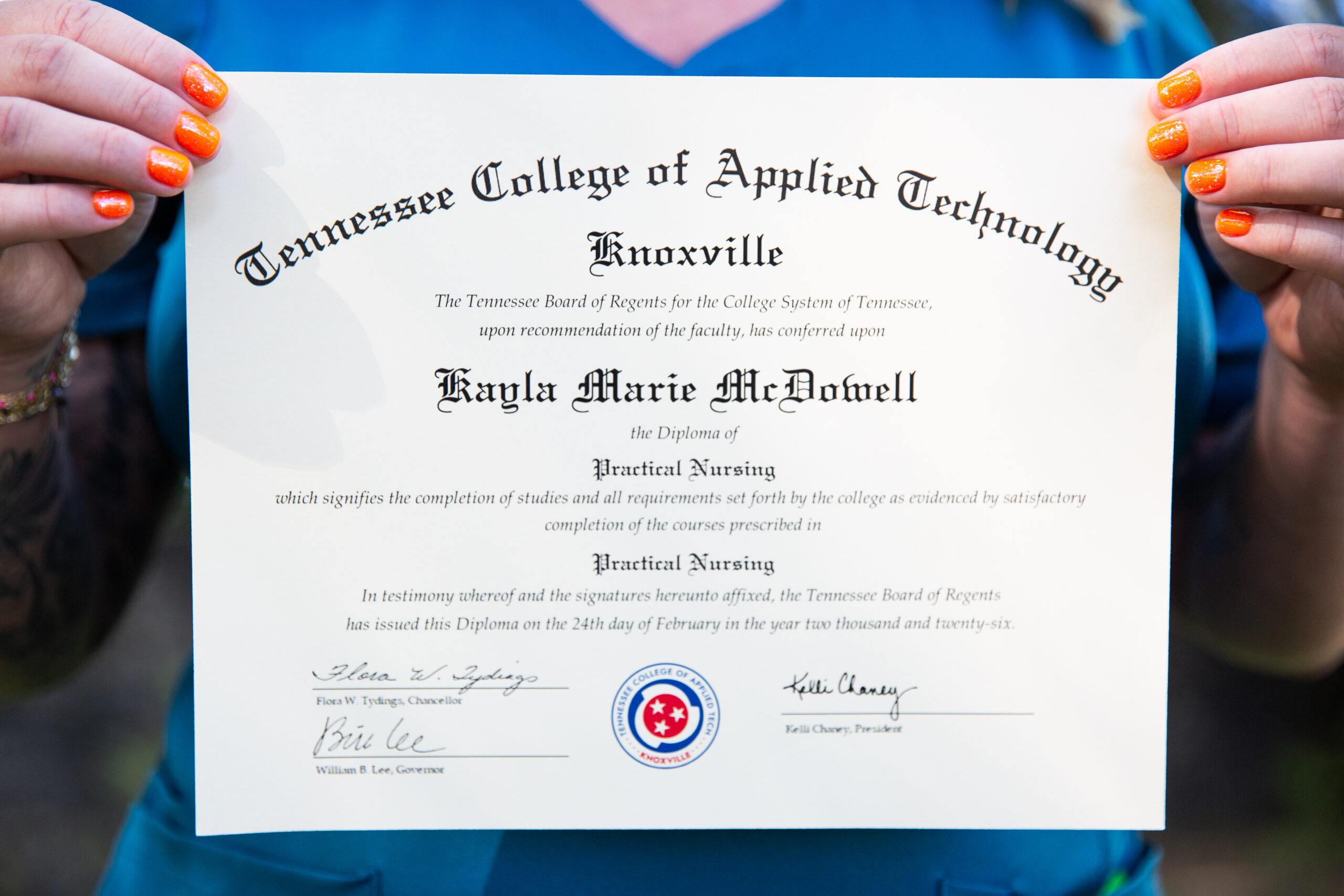
In February 2026, with her grandparents watching online, Kayla walked across the graduation stage diploma in hand. It was hard-earned.
“She had this grit and determination about her that was just unbelievable,” Courtney said.
Becoming an LPN, Unlocking Financial Freedom
In the days before her NCLEX exam, reeling from the news of her grandfather’s passing and wondering if she could make it through, she summoned that grit.
“If it’s meant to be, it’ll be,” Kayla told herself.
The next morning, she took the exam. Within 24 hours, she learned she had passed. A week after that in April of this year, she started working as an LPN — doubling her income in the process.
Financially, she’s more comfortable than she’s ever been: “I can go to the grocery store and not be looking at the price adding up in my phone. I feel like I can breathe.”
Kayla says that in the future she might go back to school for her RN. For now, she’s enjoying financial freedom and giving her daughter experiences of her own, from Dollywood to a princess show in Knoxville.
“I am the first person on both sides of my family to graduate college,” Kayla said. “Khloe tells everybody her mommy’s a nurse. I feel like I broke a generational curse.”